




This book keeps popping up on my Amazon recommendations. When I took a look inside,…
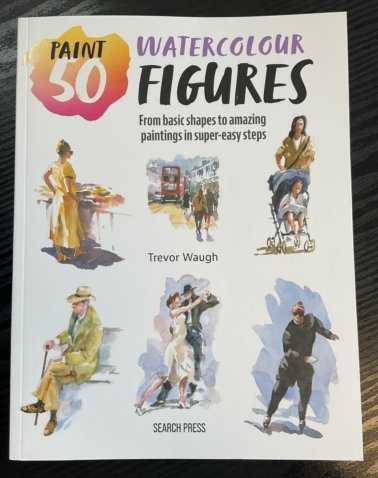
Paint 50 Watercolour Figures, Trevor Waugh: Book Review
Things are a bit quiet on the painting front at the moment. I’m playing in a correspondence chess tournament and for the last week have been returning from my morning walk to be faced with several games of chess all waiting for me to move and all so highly intense that it’s been taking a lot of time to decide on a move. And by the time I’ve cleared the backlog, it’s been feeling too late to start painting. But four of my games have finished now, leaving only four still being played and a couple of those are close to the point at which I can win by playing on autopilot, so the painting could resume very soon.
In the meantime, here’s a book review. This is one that’s been sitting near the bottom of my wishlist for a while but which tempted me this week by suddenly dropping below £10. It’s 112 page paperback, so one of the thinner books out there.
This book is all about painting figures in watercolour. Not the sort of figure painting that I’m normally into though. No, this is about loose vignettes that are more like sketches but that could also be incorporated into landscape scenes to make them more interesting. And we’re not talking simple carrot people silhouettes either. It’s somewhere between proper figure painting and simple figures. An interesting place to be.
Structure-wise we have a mercifully short ten page introduction with brief notes on materials and techniques and then we’re into fifty two-page demonstrations. Each demo is in four steps, the first of which is a pencil outline that the less confident artist could trace. Then the next three steps are about layers of paint, starting with fairly random underpaintings but with details added in the second and third layers. The knitting pattern brigade will like how Trevor lists all the colours he uses and and the arrows pointing to all the different places where he uses them. Although one thing that makes the demos difficult to follow is that the photos shown at the end of the four stages are often from four different versions of the painting rather than from one painting at four different stages.
The style of the artwork is very loose. It reminds me a lot of Charles Reid’s work in that the pencil outlines are still visible and doing a lot of the work in some places where (say) the only paint on someone’s calf is a single elliptical shape. There’s also lots of places where different colours are allowed to run together. I actually quite like the style. He does use a lot of black in his paintings though: not something I’ll be copying but I’m happy to use other dark colours.
Did I learn anything? Not much to be honest. The book is very short on tips but does teach an approach to this sort of figurework. It doesn’t teach it directly, instead letting the reader learn it through osmosis after seeing Trevor go through the process 50 times. And this technique is something that did need to be documented in a book. Is 50 demos too many? I’m going to say no. Not only is every example a little bit different but the book serves as an ideas catalogue for the types of people that could be added to a landscape to create some interest.
So this book serves two purposes: (i) a source of ideas for people to add to paintings, and (ii) teaching a loose figure painting style that could be used for vignettes or for populating landscapes. In both cases the book is more inspirational than instructive and that’s not a criticism. I may even loosen up some of my figures when I’m back to painting, even while using inktense pencils or Artgraf blocks: I’m sure this technique will work with those media too. This book is worth a place on my shelf and the cheap price was a bonus. It scores three palettes.
🎨🎨🎨
You can find this book and more reviews of it at Amazon UK here. As an Amazon Associate, I earn commission from qualifying purchases but this costs absolutely nothing extra to you
Leave a Reply