




At the time I bought this book I was only painting landscapes and my artwork…
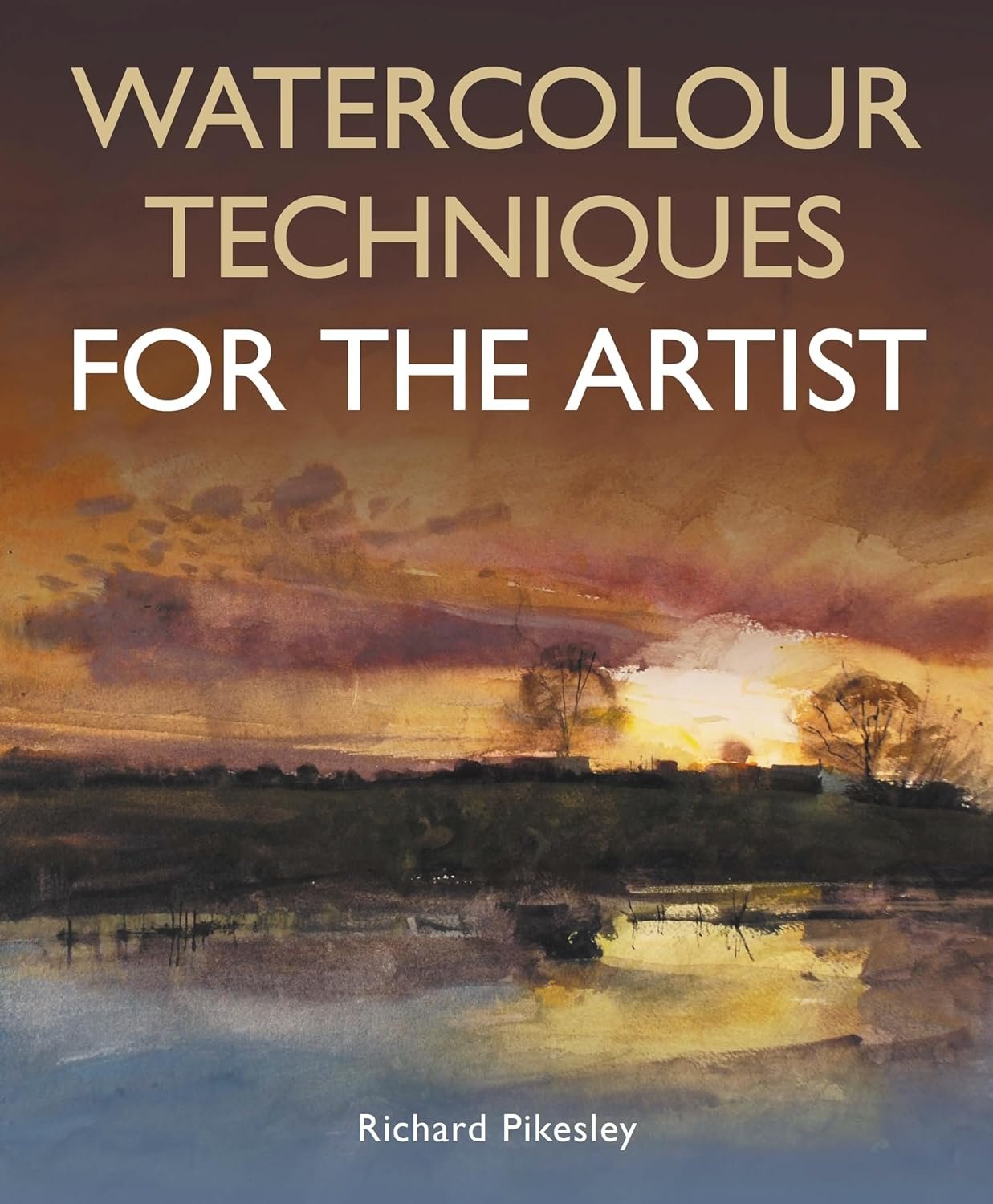
Watercolour Techniques For The Artist, Richard Pikesley- Book Review
Here’s the second of the three books that I got for Christmas. It’s a book on watercolours by Richard Pikesley, a 160 page paperback. People only have good things to say about it in reviews and I’ve been looking forward to this one for a while. Richard’s had another highly rated book out for a while specifically on landscape painting but I understand it’s more focused on painting in oils, so I’ve stayed away from it.
Chapter-wise we have:
- about 25 pages of introduction and materials. There’s a bit too much tangential stuff for my liking on the history of watercolour and what makes watercolour great. And including advice in a book on watercolour on what gouache and acrylics to buy is already raising some red flags.
- then we have about 20 pages on “the classical technique”. Stuff everybody already knows about laying down flat or graduated washes and painting wet into wet (and that’s better described in the Bridget Woods book). Some padding on history and how to create your own watercolours. Some interesting stuff on stippling but otherwise another chapter to skip.
- about 15 pages on rattling out quick watercolours in sketchbooks, mainly as an alternative to taking photos in preparation for bigger, more serious paintings. With a lot of talk about how these more serious paintings will be in oils, I’m starting to wonder whether Richard has any passion for watercolours or whether they’re just collateral damage in his oil painting process.
- a 20-page chapter on colours and colour theory. It covers all the bases but (at least in my opinion) Hazel Soan and Jeanne Dobie have come up with better explanations (by which I mean more accessible, not just deeper as a result of dedicating whole books to colours and colour theory).
- about 15 pages on still life and its close cousins flowers and indoor landscapes. One of the better chapters, with no tangential stuff, more useful tips and some amazing examples of painting views through windows that include reflections of things on our side of the window as well as direct views of what’s on the other side. A better artist than me might learn a lot from these window paintings.
- about 20 pages of “more techniques”. There’s stuff on perspective and masking fluid that isn’t news to anybody but then a lot of stuff on mixed media that I’m not especially into but others might be.
- then we have about 10 pages on “painting all the way”, a collection of tips that could easily have been combined with the previous chapter. There’s stuff on composition, working in layers, varying edges, etc but nothing new or revolutionary.
- then it’s 20 pages on painting landscapes. There’s a reminder of the need to create space using aerial perspective and some stuff about working en plein air with the challenge of changing light and shadows. There are little subheadings in this chapter on painting the sea, skies and snow but with little or no substance underneath them. A disappointing chapter, slightly redeemed by a couple of pages at the end on abstractifying landscapes.
- and 15 pages on “moving on”. There’s some decent stuff in this chapter on how it’s often shadows that turn urban scenes into amazing composition and on putting people into paintings (I can’t tell you whether the new Hazel Soan book does a better job as I don’t have it yet). And a couple of pages on mounting, framing and sharing your work.
- and, after the list of contributing artists and the index, that’s us done.
There are five or six demonstrations in the book, all of them difficult to follow because there are too few steps and because the interim paintings we’re shown are too small. It’s difficult to look at two successive paintings and to work out all the different things that have changed. Sometimes, if all that’s changed is the addition of an extra layer of similarly coloured paint, it’s hard to see whether anything has changed at all. The knitting pattern brigade will hate these demos as they’re not paint-along-with-me exercises, but I don’t like them either as I see little point in demos where I can’t see what’s happening.
There are a few exercises scattered throughout the book on getting used to brushes, colours, etc but (unlike my experience while reading Bridget Woods) I felt little compulsion to join in with them.
Sometimes the paintings in a book can be the redeeming feature. They may or may not be in this book – I’m not sure. Most of the paintings on show are Richard’s, although other artists are also featured and credited appropriately. And most of Richard’s paintings are landscapes, with some still lifes, flowers and indoor landscapes thrown in for good measure. And Richard’s style is loose and semi abstract, with many of them looking as if the paint had been spilled onto the paper. It’s very different to my style and, I suspect, one that, if I tried to emulate it, would result in lots of paintings that I would deem to be clunkers. But maybe I should try this sort of thing at some point. You stand still, you start moving backwards.
Did the author have a voice? If he did, it’s not one that I enjoyed listening to. The two things that stand out to me after listening in my head to Richard while reading this book are:
- he’s mentally disorganised. This book felt like a random stream of consciousness, switching between subjects and going off at tangents. It needed a better editor to group his thoughts into neat, compartmentalised chapters.
- he’s not a fan of watercolours. I remember reading a book in my chess-playing days on the French Defence in which the author said that it wasn’t enough for someone writing a book on the French (or was it for someone playing the French?) to understand it, they had to love it. A very true statement and one that I think also applies to watercolours. Unfortunately Richard doesn’t love watercolours – they seem to “fill a hole” when he can’t use oils. It also didn’t escape my notice that most of his watercolour paintings are labelled as being A4 size or smaller, with many of them being A6. That also says something.
And the final verdict? Well, as you can probably tell, I’m hugely disappointed. This is an author who doesn’t love watercolours, who has little (if anything) new to bring to the table, who goes over everything we already know but not as well as those we learned it from and whose writing style is scattergun and unfocused. I can’t tell whether this book is aimed at beginners (who I expect would find it too inaccessible) or at experienced artists (who will be disappointed at the shortage of original ideas). In his defence there are a couple of new ideas or reinforcements of existing ideas that I needed. And his paintings are an interesting style that makes me wonder whether what I think of as irredeemable errors in my paintings would work as interesting features in one of Richard’s.
It’s not a book I hate but not one that I’d replace if my studio burnt down, so it gets two palettes. It whoever bought me this for Christmas is reading this, don’t be disappointed and don’t think me ungrateful. I judge Christmas books ex ante, not ex post. That means this was a great present as it was a book I really wanted.
🎨🎨
If this hasn’t put you off, you can find this book and more reviews of it at Amazon UK here. As an Amazon Associate, I earn commission from qualifying purchases but this costs absolutely nothing extra to you.
Leave a Reply